
One of the most common questions when people start a granny square project is 'How big will this actually be?' This question is important because the sizing of your granny square matters for multiple reasons:
- You require specific measurements for your project (For example, for cardigans or crib blankets).
- You have a limited amount of yarn, so you don't want to run out prematurely.
- If you have a more complicated granny pattern, simply 'adding' a round isn't always as straightforward as it sounds.
Whether you're planning a blanket, a bag, or a pillow, knowing the size of your granny square before you start saves a lot of frogging later.
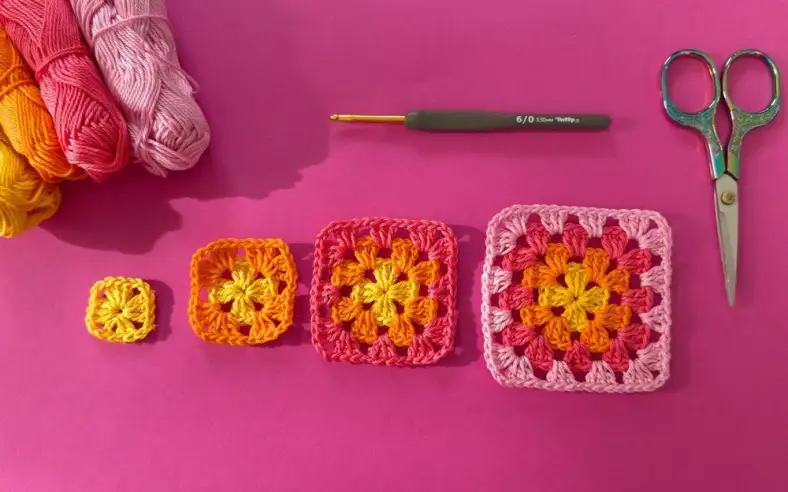
This size chart provides measurements per round for the most common yarn weights, so you can plan your project in advance. Do the prep work and reap the benefits when you crochet!
Granny Square Sizes at a Glance
Measurements for a basic granny square are after a light block.
Fingering/Sports weight (~ 3.5 mm hook)
| Rounds | Approx. size (cm) | Approx. size (in) |
|---|---|---|
| 1 | 3 × 3 cm | 1¼ × 1¼" |
| 2 | 6 × 6 cm | 2½ × 2½" |
| 3 | 9 × 9 cm | 3½ × 3½" |
| 4 | 12 × 12 cm | 4¾ × 4¾" |
| 5 | 15 × 15 cm | 6 × 6" |
| 6 | 18 × 18 cm | 7 × 7" |
| 7 | 21 × 21 cm | 8¼ × 8¼" |
| 8 | 24 × 24 cm | 9½ × 9½" |
So, each round in fingering/sportsweight yarn adds approximately 3 cm/1¼ in.
Worsted / Aran weight (~ 5 mm hook)
| Rounds | Approx. size (cm) | Approx. size (in) |
|---|---|---|
| 1 | 4 × 4 cm | 1½ × 1½" |
| 2 | 8 × 8 cm | 3 × 3" |
| 3 | 12 × 12 cm | 4¾ × 4¾" |
| 4 | 16 × 16 cm | 6¼ × 6¼" |
| 5 | 20 × 20 cm | 8 × 8" |
| 6 | 24 × 24 cm | 9½ × 9½" |
So, each round in worsted/aran yarn adds approximately 4 cm/1½ in.
Bulky weight (~ 6.5mm hook)
| Rounds | Approx. size (cm) | Approx. size (in) |
|---|---|---|
| 1 | 5 × 5 cm | 2 × 2" |
| 2 | 10 × 10 cm | 4 × 4" |
| 3 | 15 × 15 cm | 6 × 6" |
| 4 | 20 × 20 cm | 8 × 8" |
| 5 | 25 × 25 cm | 10 × 10" |
So, each round in bulky yarn adds approximately 5 cm/2 in.
Good to know: Your squares may be slightly smaller or larger depending on your personal gauge and the specific yarn you're using. Always crochet a test square to check your own size before starting a big project.
What affects the size of a granny square?
- Yarn weight is by far the biggest factor. Yarn weight refers to how thick a yarn is, and a thicker yarn produces a bigger square than the same pattern with a thinner yarn. If you're following a pattern, always use the recommended yarn weight to get the stated size.
- Hook size has a big influence too. Using a larger hook with the same yarn creates a looser, airier square, while using a smaller hook makes it denser and slightly smaller. This makes sense if you think about it: a bigger hook makes bigger loops, and thus your stitches get taller. Most yarn labels suggest a hook size, but going up or down half a size is normal depending on your personal tension (see next point).
- Your personal tension comes into play as well. Some crocheters naturally work tightly (smaller squares), others more loose (larger squares). There's no right or wrong about this; it's simply how you learned to crochet. Measure your own finished square and use that measurement to plan your project. Personally, I'm a tight crocheter (I keep a moderately tight grip on my yarn and pull the stitch when it's finished), so I know to go up a hook size compared to what the label recommends.
Quick reference: common project sizes
| Project | Typical square size | Rounds in DK |
|---|---|---|
| Coaster | 10 × 10 cm (4 × 4") | 3–4 rounds |
| Cushion cover (40 × 40 cm / 16 × 16") | 20 × 20 cm (8 × 8") | 6–7 rounds |
| Baby blanket (80 × 100 cm / 31 × 39") | 10–15 cm (4–6") | 3–5 rounds |
| Throw blanket (120 × 150 cm / 47 × 59") | 15–20 cm (6–8") | 5–6 rounds |
| Tote bag | 15 × 15 cm (6 × 6") | 5 rounds |
How to measure your own granny square
If you want to be precise, always measure your own test square before starting a full blanket. I recommend doing so, especially for large projects.
- Crochet a square with your yarn and hook size.
- Block the square (either wet or spray block it) and let it dry completely.
- Lay the square on a flat surface and measure.
- Use that measurement to plan how many squares you need.
Blocking makes your square larger, which is why it's important to measure after blocking, not before.
How many granny squares do I need for a blanket?
Once you know your square size, calculating the number of squares for a blanket is straightforward:
- Decide on your finished blanket size (for example, 120 × 150 cm / 47 × 59").
- Divide the width by your square size: 120 ÷ 15 = 8 squares wide.
- Divide the height by your square size: 150 ÷ 15 = 10 squares tall.
- Multiply this: 8 × 10 = 80 squares total.
Keep in mind that your joining method can add a few millimetres between squares, which may slightly affect the total count. Join-as-you-go (in which you join the last round of the motif to the previous motif) only adds a few mm's, but fancy decorative joins can add the equivalent of a round (or more).
Ready to start?
Now that you know how big your square will be, here are the next steps:
- New to granny squares? Start with my step-by-step granny square tutorial. It covers the basic pattern with photos for every step.
- Not sure which yarn to use? My complete yarn guide for granny squares explains which fibres give the cleanest stitch definition.
- Planning a blanket? Read the article on how many granny squares you need for a blanket before you get started.
Comments
Be the first to comment to this post!