
Yarn ends: the inevitable ending to any yarn project. As with any craft, there are so many ways to 'fasten off' that you might get confused by all the different methods. Let me tell you what does (and doesn't) work for me.
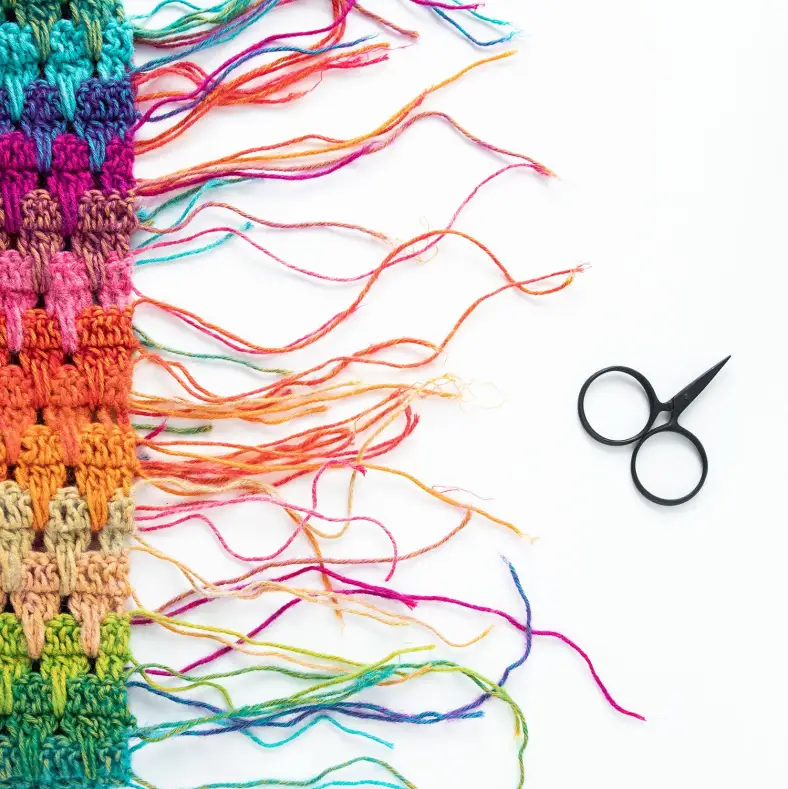
Basically, there are three ways to work away your ends. Knotting, Russian Join and Weaving. Here's a quick overview of their pros and cons:
| Method | Colour Control | Quickness | Security |
|---|---|---|---|
| Knotting | Yes | Yes | Little |
| Russian join | No | No | Depends on your skill |
| Weaving in | Full | No | Yes |
Why shouldn't you knot your yarn ends?
Like my 89-year-old grandma says: 'real crafters don't knot.' Granted, my grandma has never tried macramé, but she was on to something. When knots come undone, you have little yarn left to knot again. And they come undone at some point. Laundry softener and smooth yarns will loosen over time, creating slack. Imagine your finished blanket coming out of the delicate laundry, with as many yarn ends poking out as you started with. If your stitches haven't unravelled first, that is. So take my grandma's advice: don't knot.
What Is the Russian join, and when should you use it?
Okay, so why not use the Russian join method and get rid of those yarn ends altogether? The Russian join is a method of splicing yarns and winding their ends into one another, thereby fastening them together without visible ends to fasten off. I'm not a big fan of this type of join. For one, it's challenging to predict exactly where the colour change will occur in your work. Possibly, halfway through a stitch. When they get undone, you again have little yarn left to fix it with. Some people swear by this method, just not me.
How do you weave in yarn ends?
So what is the right way, according to me? It's weaving them in. Preferably with a sharp needle, weaving the strands into the stitches and back into itself ensures they stay put. Even if the yarn end gets undone, you still have a proper amount of yarn left to weave back in again. And to top it off, you have full control over where your yarn changes colour.
Is there a downside to his method? Well, it's more time-consuming than knotting, and you might poke yourself with a sharp needle once or twice. Other than that, it produces the prettiest, neatest results.
Video: How to weave in yarn ends
I've created a video tutorial to show you how to weave in those ends, including a few tricks I've picked up over the years. All you need is a needle (preferably sharp) and a pair of scissors.
Video tutorial
Comments
Jennifer Whittaker
September 13, 2021 20:53
Jennifer Whittaker
September 13, 2021 20:53
Dehlia
September 16, 2021 21:11
Dehlia
September 16, 2021 21:11
Dehlia
September 16, 2021 21:11
Dehlia
September 16, 2021 21:14
Carol
December 17, 2021 15:23
Simona
September 30, 2023 12:22
Kirsten
September 30, 2023 13:42